
State of the Electronic Components Market: September 2026
Headline Inflation Cools, but Memory Lead Times Surge
Lytica is the world’s only buyer-powered agentic AI supply chain platform, built on real customer transactional data. The SupplyLens™ Pro platform gives procurement teams the clarity and leverage to cut costs in negotiations, reduce supply risk, and make good decisions from design to source. The world’s top OEMs and EMS providers tell us the same thing: before Lytica, they were operating in the dark.
As a result of this unique position in the marketplace, we’ve been able to work with hundreds of customers in analyzing over $550+ billion in electronics spend. We’ve curated up-to-date insights on the state of the electronic component market and will be sharing them with you each month here. Subscribe today to receive these each month upon release.
Lytica’s component basket of goods used in our analysis is comprised of 165,000 electronic components across more than 30 categories, consisting of the most popular devices used by our customers. These indices are intended to show trends in the market. Individual component and BoM analysis is offered by Lytica as a service to our customers. Request a demo to see it in action.
⚡ Key Takeaway Summary
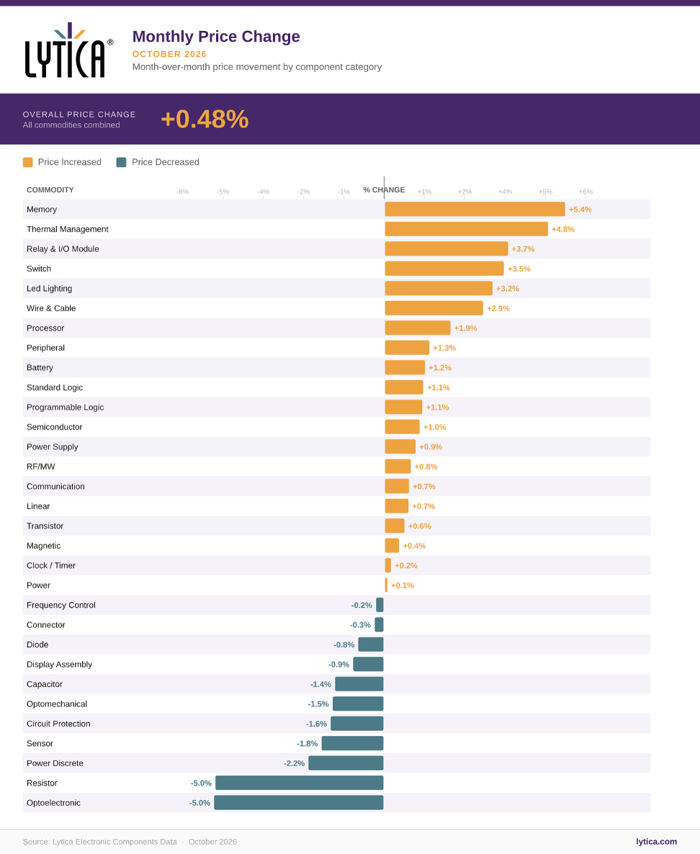
October brought a sharp reset in headline pricing after September's broad repricing. Lytica's overall electronic component price index increased just +0.48% month over month, down from +2.98% in September and the lowest monthly reading in the 2026 dataset. Twenty of the 31 categories tracked moved higher, while 11 declined.
The overall lead time index was +1.92%, essentially unchanged from September's +1.89%. The headline masks extreme category divergence: Memory lead time surged +57.3%, followed by Power (+19.5%), Communication (+18.6%), Processor (+17.7%), and Standard Logic (+10.0%). At the same time, LED Lighting (-42.2%), Optomechanical (-27.2%), and Semiconductor (-11.1%) compressed sharply.
Stock availability remained broadly healthy at 95.0% overall, versus 95.23% in September, and 18 categories show availability of at least 95%. The exception is Battery, where availability fell from 82.0% to 71.5%. Display Assembly also deteriorated materially to 84.0% from 96.2%.
Memory is October's clearest combined risk signal: price increased +5.36% while lead time extended +57.3%, even with 96.5% current availability. That combination points to replenishment pressure and future coverage risk rather than a market that is already depleted on the shelf.
Action required: Prioritize Memory immediately, then review Power, Communication, Processor, and Standard Logic for Q4/Q1 delivery exposure. Keep Battery on an urgent availability watch, and validate Thermal Management and Wire & Cable pricing where AI infrastructure or high copper content is material to the BOM.
What Drove Electronic Component Price Changes in October 2026?
October was a fragmentation month. The overall price index fell to +0.48% from +2.98% in September, but that does not mean component inflation disappeared. Twenty categories still increased, led by Memory (+5.36%) and Thermal Management (+4.85%), while 11 categories declined. The broad, nearly universal repricing seen in September broke apart into much more category-specific movement.
Overall price index: +0.48% MoM, down from +2.98% in September
Highest increase: Memory +5.36%
Thermal Management +4.85%; Relay & I/O Module +3.66%; Switch +3.54%
LED Lighting +3.20%; Wire & Cable +2.92%; Processor +1.95%
Twenty categories increased; 11 categories declined
Largest declines: Optoelectronic -5.04% and Resistor -5.00%
Memory: October's Clear Cost-and-Delivery Warning
Memory prices increased +5.36% in October, up from +3.48% in September. The more important move is lead time: +57.3% in October versus only +0.4% in September. Availability remains high at 96.5%, so the current signal is not broad stock depletion - it is a rapid extension in replenishment windows.
TrendForce's 4Q26 outlook continues to show suppliers prioritizing server DRAM and advanced memory capacity, with conventional DRAM contract prices projected to rise 10-15% quarter over quarter and NAND Flash 15-20%. Future Electronics' October market update also lists DRAM and storage among the categories facing allocation from multiple vendors.
Procurement implication: Treat current availability as a temporary buffer, not proof of normalization. Validate forward coverage by memory type and density, and separate near-term channel stock from factory replenishment commitments.
Thermal Management and Wire & Cable: Infrastructure Cost Pressure Persists
Thermal Management rose +4.85% in October, while Wire & Cable increased +2.92%. Neither category is showing an equivalent lead-time surge: Thermal Management lead time rose only +1.8%, while Wire & Cable compressed -1.4%. The data therefore point more toward cost and demand mix than broad shortage conditions.
Sourceability's Q3 lead-time review notes that AI infrastructure demand is now affecting an ecosystem well beyond processors and memory, including cooling, power conversion, networking, connectors, capacitors, and embedded controllers. Copper also remained historically elevated through October, with S&P Global highlighting structural demand from power grids, data centers, and electrification alongside constrained mine supply.
Procurement implication: For cooling- and copper-intensive BOMs, revalidate current contracted pricing even where lead times appear stable. Cost exposure can move independently of delivery windows.
September's Biggest Price Spikes Reverse
October also produced several sharp reversals. Optoelectronic moved from +8.46% in September to -5.04% in October, Resistor from +6.26% to -5.00%, and Power Discrete from +5.34% to -2.23%. Diode also moved from +6.60% to -0.75%.
This is why October should not be described as a simple continuation of September. The market is rotating quickly between categories, and recent price direction at the MPN level matters more than the prior month's headline move.
Which Electronic Component Categories Experienced the Largest Lead Time Extensions in October 2026?
The overall lead time index was +1.92% in October, nearly unchanged from +1.89% in September. But category-level behavior was unusually polarized. Twenty categories extended, five compressed, and six were flat. Memory's +57.3% increase dominates the month, while several categories moved sharply in the opposite direction.
Overall lead time index: +1.92% MoM, versus +1.89% in September
Memory: +57.3%
Power: +19.5%; Communication: +18.6%; Processor: +17.7%
Standard Logic: +10.0%
Largest compressions: LED Lighting -42.2%; Optomechanical -27.2%; Semiconductor -11.1%
Six categories were flat
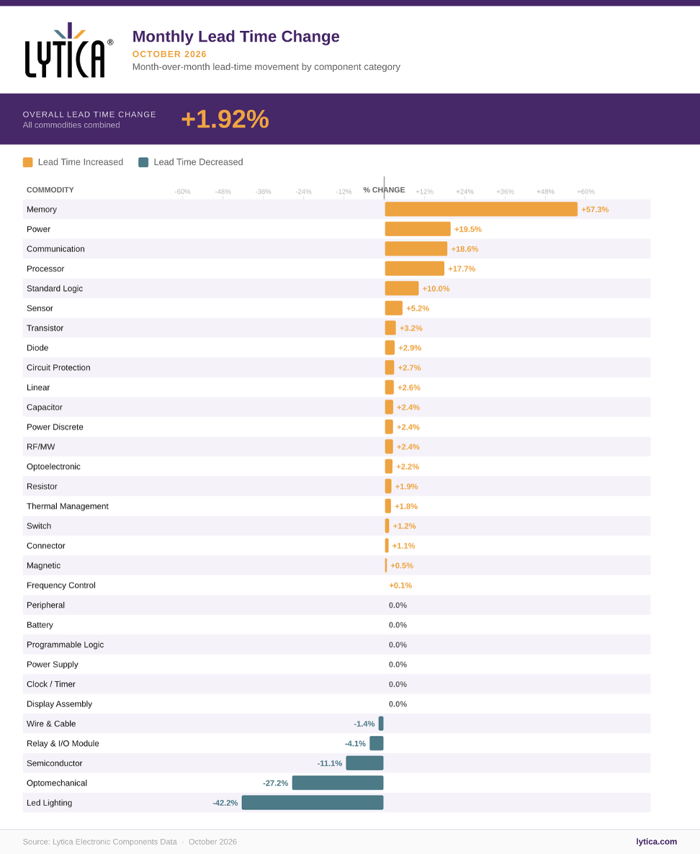
Figure 2: Monthly Lead Time Change by Category - October 2026. Source: Lytica Electronic Components Data.
⚠️ Risk Alert: Memory Leads a New Replenishment-Wave Signal
October's lead-time data are not a market-wide shortage signal. They are a concentrated warning around Memory and several infrastructure-linked categories. Memory (+57.3%), Power (+19.5%), Communication (+18.6%), Processor (+17.7%), and Standard Logic (+10.0%) all extended materially while current availability remained high.
Future Electronics reported in October that allocation is appearing across DRAM, storage, small-signal and bipolar devices, MOSFETs, MLCCs, and selected microcontroller and analog products. Sourceability similarly describes a market where AI infrastructure demand is spreading into power, cooling, storage, networking, connectors, and embedded controllers.
What to watch: High availability can coexist with worsening factory replenishment. Procurement teams should validate supplier-confirmed lead times and allocation status before relying on current distributor inventory as evidence of low risk.
Power, Communication, and Processor: Delivery Pressure Without Current Scarcity
Power, Communication, and Processor lead times increased +19.5%, +18.6%, and +17.7%, respectively. Yet availability remains 99.4% for Power, 96.7% for Communication, and 98.0% for Processor. Price movement is also modest compared with Memory: +0.07%, +0.71%, and +1.95%.
This is an early-warning pattern rather than a current-stock crisis. The replenishment window is stretching before availability or category-level price data fully reflect the pressure.
LED Lighting, Optomechanical, and Semiconductor: Lead Times Normalize Sharply
The opposite pattern is visible in LED Lighting (-42.2%), Optomechanical (-27.2%), and Semiconductor (-11.1%). Optomechanical is the clearest reversal from September, when lead time increased +14.7% and price rose +6.2%. In October, price fell -1.5% while lead time compressed dramatically and availability reached 100%.
These reversals materially offset the Memory spike in the overall index and reinforce the need to read October at the category level rather than from the +1.92% headline alone.
What Is the Current Stock Availability for Electronic Components in October 2026?
Overall stock availability remained broadly stable at 95.0% in October, compared with 95.23% in September. Eighteen of the 31 tracked categories show availability of at least 95%. The headline is healthy, but the lower end of the distribution deteriorated meaningfully.
Battery: 82.0% -> 71.5%
Display Assembly: 96.2% -> 84.0%
Connector: 89.6% -> 88.3%
Frequency Control: 89.0% -> 87.9%
Resistor: 84.3% -> 87.5%
Memory: 95.6% -> 96.5% despite the lead-time surge
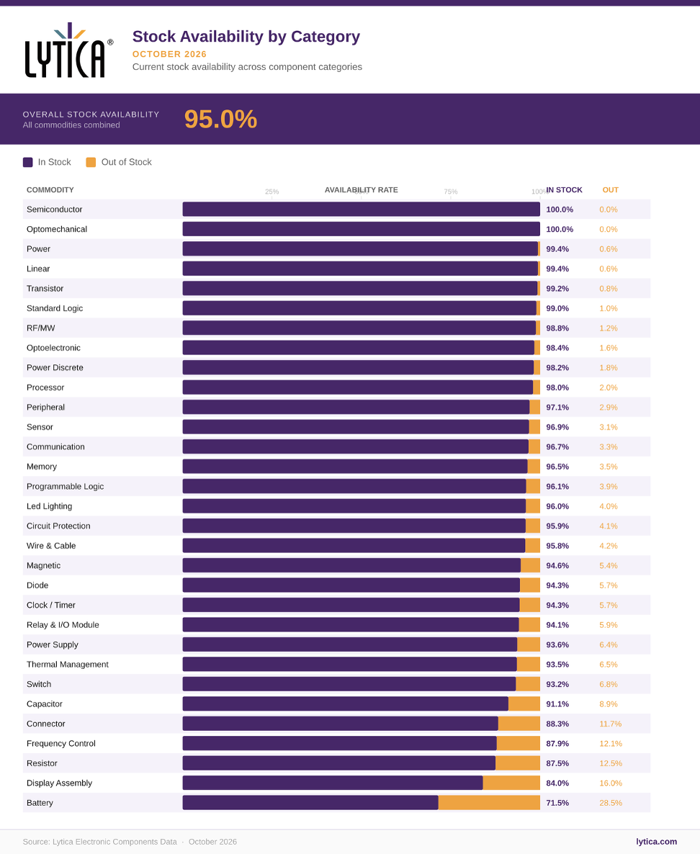
Figure 3: Monthly Stock Availability by Category - October 2026. Source: Lytica Electronic Components Data.
Tightest Availability Categories
Battery - 71.5%: By far the lowest availability in October, down more than 10 percentage points from September. Price increased +1.19% and lead time was flat, so the immediate signal is current-stock constraint rather than a new delivery-window spike.
Display Assembly - 84.0%: Availability fell sharply from 96.2% in September, while price declined -0.9% and lead time was flat. TrendForce expected October large-generation panel utilization to fall as end demand weakened, so the Lytica result should be assessed at the specific part and channel level rather than treated as a broad display shortage.
Resistor - 87.5%: Availability improved from September, but remains among the tightest categories. Price reversed sharply to -5.0% while lead time increased +1.9%.
Frequency Control - 87.9%: Availability remains below 90%, but price declined -0.2% and lead time was essentially flat.
Connector - 88.3%: Availability remains constrained even as average price fell -0.3%. Amphenol reported record Q3 sales and a 1.19 book-to-bill ratio, showing that connectivity demand remains strong despite October’s modest category-level price decline.
Key point: October’s 95.0% overall availability masks a more uneven market than the headline suggests. Battery and Display Assembly now require the closest stock-level attention, while Memory requires forward-delivery attention even though current availability is high.
How Has the Overall Electronic Component Price Index Trended in 2026?
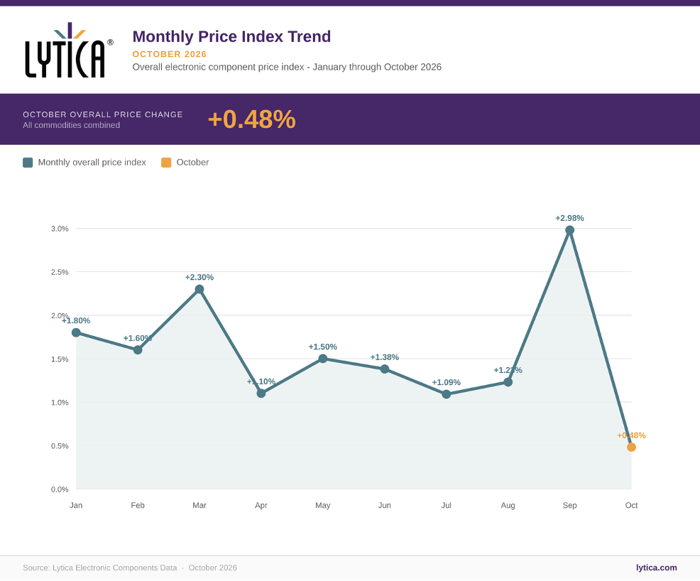
Figure 4: Monthly Price Index Trend - January to October 2026. Source: Lytica Electronic Components Data
October's +0.48% reading is the lowest overall monthly increase in the 2026 dataset and follows September's +2.98% peak. The sequence shows how quickly pricing pressure can rotate: September produced broad repricing across almost every category, while October returned to a split market with 20 increases and 11 declines.
Market read: Headline inflation cooled sharply, but risk did not disappear. October is a category-selection month: Memory and several processing/power families are tightening on lead time, while other categories are actively deflating or normalizing.
What Should Procurement Leaders Do Right Now? October 2026 Action Items
🔴 Urgent – Act This Month
Memory: Price +5.36%, lead time +57.3%, availability 96.5%. Validate forward commitments and factory lead times now. Current stock is not a substitute for replenishment coverage.
Battery: Availability 71.5%, the lowest in the basket. Lead time is flat, so focus on current stock, supplier-specific inventory, and alternate-source coverage.
Power / Communication / Processor: Lead times increased +19.5%, +18.6%, and +17.7%. Secure critical Q4/Q1 demand before high current availability begins to erode.
🟡 Monitor Closely – 30-60 Day Window
Thermal Management: Price +4.85% with only +1.8% lead-time movement. Treat as a cost exposure and revalidate pricing where AI/data-center cooling demand matters.
Wire & Cable: Price +2.92% while lead time compressed. Copper remains structurally expensive and exposed to power-grid, data-center, and electrification demand.
Standard Logic: Lead time +10.0% with 99.0% availability and +1.14% price. This is an early planning signal rather than a current shortage.
Stable / Improving – Keep on the Watch List
Optoelectronic / Power Discrete / Sensor: Prices declined -5.04%, -2.23%, and -1.84%, respectively. Do not assume September repricing will persist uniformly across these categories.
Optomechanical / Semiconductor: Lead times compressed -27.2% and -11.1%, and both show 100% current availability.
Connector: Price declined slightly, but availability remains below 90% and major supplier order activity remains strong.
FAQ: Electronic Component Market - October 2026
Q: How did electronic component prices change in October 2026?
Lytica's overall electronic component price index increased +0.48% month over month in October, down from +2.98% in September and the lowest monthly reading in the 2026 dataset. Twenty categories increased and 11 declined. Memory recorded the largest increase at +5.36%, followed by Thermal Management (+4.85%), Relay & I/O Module (+3.66%), Switch (+3.54%), and LED Lighting (+3.20%).
Q: Which electronic components experienced the largest lead-time extensions in October 2026?
Memory recorded the largest extension at +57.3%, followed by Power (+19.5%), Communication (+18.6%), Processor (+17.7%), and Standard Logic (+10.0%). The overall lead-time index was +1.92%, almost unchanged from September because large compressions in LED Lighting, Optomechanical, and Semiconductor offset the increases.
Q: Is electronic component availability getting better?
Overall availability remained broadly stable at 95.0%. However, Battery fell to 71.5% and Display Assembly to 84.0%. At the same time, several categories with the largest lead-time increases still show availability above 95%, so current stock alone does not capture forward supply risk.
Q: Why is Memory the biggest October concern if availability is still high?
Because current availability and factory replenishment are different signals. Memory availability is 96.5%, but lead time increased +57.3% and price +5.36%. External market data also show capacity continuing to prioritize server and AI memory. The risk is that today’s inventory buffer may not be easy to replace on the same timeline or price.
Q: What changed most from September to October?
The broad September repricing event broke apart. The overall price index fell from +2.98% to +0.48%, and 11 categories declined. Overall lead time stayed almost unchanged, but the pressure shifted dramatically into Memory, Power, Communication, Processor, and Standard Logic. October is therefore a more fragmented market with concentrated supply risk rather than universal inflation.
Sources and References
The following sources were consulted to provide broader market context alongside Lytica's proprietary October 2026 data. September-to-October comparisons use Lytica's September report as the prior-month published reference.
Lytica, State of the Electronic Components Market: September 2026
TrendForce, AI Server Demand Sustains Memory Contract Price Increases in 4Q26, September 30, 2026
Future Electronics, Market Conditions Report, updated October 19, 2026
Sourceability, Q3 2026 Lead Time Report Highlights, October 14, 2026